
Types of Permanent Magnet Materials
Strontium Ferrite / Ferrite / Ceramic
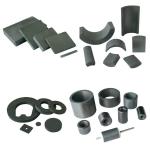
Ceramic, also known as Ferrite, magnets are made of a composite of iron oxide and barium/strontium carbonate. These materials are readily available and at a lower cost than other types of materials used in permanent magnets making it desirable due to the lower cost. Ceramic magnets are made using pressing and sintering. These magnets are brittle and require diamond wheels if grinding is necessary. These magnets are also made in different grades. Ceramic-1 is an isotropic grade with equal magnetic properties in all directions. Ceramic grades 5 and 8 are anisotropic grades. Anistropic magnets are magnetized in the direction of pressing. The anisotropic method delivers the highest energy product among ceramic magnets at values up to 3.5 MGOe (Mega Gauss Oersted). Ceramic magnets have a good balance of magnetic strength, resistance to demagnetizing and economy. They are the most widely used magnets today.
| Positive | Negative |
| Low Cost | Low Energy Product |
| High Coercive Force | Low Mechanical Strength – Brittle |
| High Resistance to Corrosion |
Alnico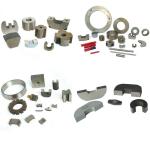
Alnico magnets are made up of a composite of aluminum, nickel and cobalt with small amounts of other elements added to enhance the properties of the magnet. Alnico magnets have good temperature stability, good resistance to demagnetization due to shock but they are easily demagnetized. Alnico magnets are produced by two typical methods, casting or sintering. Sintering offers superior mechanical characteristics, whereas casting delivers higher energy products (up to 5.5 MGOe) and allows for the design of intricate shapes. Two very common grades of Alnico magnets are 5 and 8. These are anisotropic grades and provide for a preferred direction of magnetic orientation. Alnico magnets have been replaced in many applications by ceramic and rare earth magnets.
| Positive | Negative |
| High Corrosion Resistance | High Cost |
| High Mechanical Strength | Low Coercive Force |
| High Temperature Stability | Low Energy Product |
Samarium Cobalt
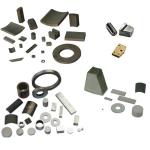
| Positive | Negative |
| High Corrosion Resistance | High Cost |
| High Energy Product | Low Mechanical Strength – Brittle |
| High Temperature Stability | |
| High Coercive Force |
Neodymium Iron Boron
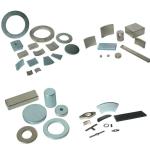
| Positive | Negative |
| Very High Energy Product | Higher Cost (Except from us!) |
| High Coercive Force | Low Mechanical Strength – Brittle |
| Moderate Temperature Stability | |
| Low Corrosion Resistance (When uncoated) |
Flexible Rubber Magnet
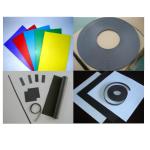
Flexible magnets are very similar to the injection molded magnets but are produced in flat strips and sheets. These magnets are lower in magnetic strength and very flexible depending on the materials that was used in the compound with the magnetic powders. Vinyl is often used in this type of magnet as the binder.
| Positive | Negative |
| Low Cost | Low Energy Product |
| High Corrosion Resistance | Low to Medium Temperature Stability |
| Moderate Coercive Force |